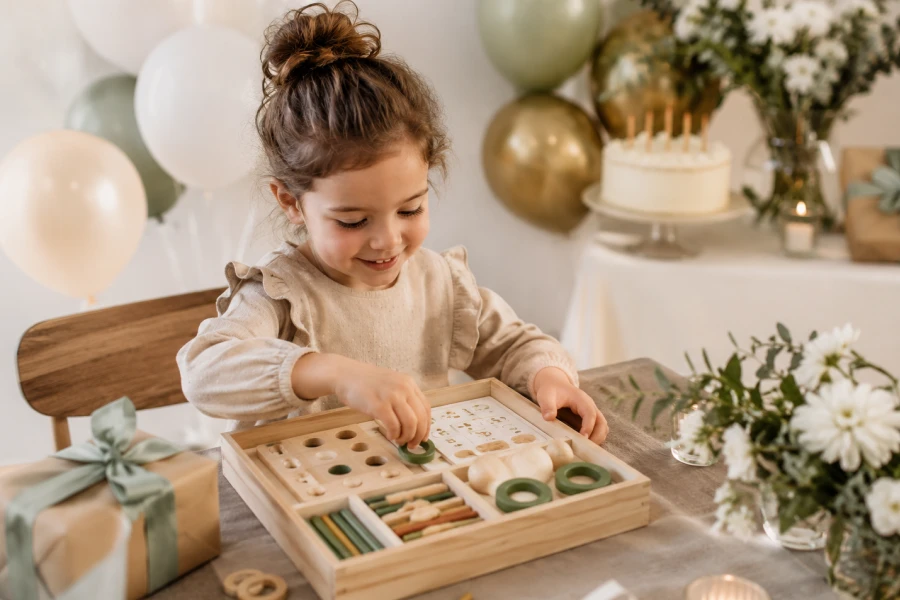
Four-year-olds learn by moving, repeating, inventing, and proudly showing what they made. Gifts for 4 year olds are most exciting when they give that energy somewhere to go. At this age, a simple object can become a house, a rocket, a bakery, or a treasure map. The best options welcome imagination instead of dictating one correct outcome. They also allow children to return to the same activity in a new way tomorrow. That sense of possibility is more valuable than a momentary surprise. Parents and gift givers can support it by noticing the child’s current interests. A child who loves animals may want stories and scenes to build around them. A child who loves sorting may enjoy a toy that quietly turns practice into play. When a gift meets a real curiosity, learning becomes a joyful side effect.
The birthday reveal is only the beginning of a good children’s gift. Look for an option that invites play after the wrapping paper disappears. Open-ended toys are especially useful because they can grow with a child’s ideas. Blocks become towers one day and a pretend bakery the next. Figurines can become heroes, guests, or characters in a made-up adventure. Explore playful birthday learning when you want gift ideas that support more than a single afternoon. Repetition matters because children learn confidence by trying familiar tasks again. Each return gives them a chance to add a new detail or solve a new problem. That kind of play feels satisfying without requiring adult correction. A lasting gift provides a starting point and lets the child do the rest.
Young children often reveal what they need by repeating the same kind of play. They may line up objects, build and rebuild, role-play family routines, or create sound effects. Choose a gift that gives structure to the pattern they already enjoy. A child who sorts may love pieces that can be grouped by shape or color. A child who tells stories may enjoy simple characters, scenery, or costumes. Do not worry if the toy seems basic at first glance. For a preschooler, depth comes from what they can do with it repeatedly. One familiar activity can produce dozens of different play sessions. That is why durable, flexible materials often outperform highly complicated gadgets. They leave space for the child’s own ideas to lead.
Curiosity at four is wonderfully direct and full of unexpected connections. A strong gift can meet that curiosity without turning playtime into a lesson. Choose materials that encourage questions about balance, nature, color, movement, or stories. For example, a simple building set can lead to conversations about tall, wide, heavy, and steady. Find age-appropriate toy choices when you want options that feel exciting and manageable at the same time. The goal is not to teach every concept immediately. It is to give children opportunities to notice and ask. Adults can respond with interest rather than taking control of the activity. That approach protects the child’s ownership of the experience. When children feel capable, they become more willing to explore unfamiliar ideas.
A thoughtful gift becomes more useful when it connects with a child’s present obsession. Watch what they point out on walks, ask for at bedtime, or collect in pockets. These clues can be more useful than a broad age label. A dinosaur lover may enjoy a play scene more than a generic construction set. A child fascinated by cooking may delight in arranging pretend ingredients or serving family members. Follow enthusiasm rather than choosing the most complicated option available. Enthusiasm keeps a child engaged long enough to invent, repeat, and improve. It also makes the gift feel personal to them, even at a young age. The best choice should make the child feel that their current interests were truly noticed. That recognition is a gift in its own right.
Adult involvement can enrich play without taking over the child’s world. Sit nearby, follow the child’s lead, and offer simple questions when invited. You might ask where a pretend character is going or what a structure needs next. Use curiosity-led play for ideas that make shared moments easy and natural. The child should remain the director of the game. Adults are there to notice, encourage, and sometimes hold a piece in place. This light participation helps children feel seen without making them perform. It also gives families a practical way to turn a gift into connection. Even ten quiet minutes of shared play can become a favorite part of the day. That is a valuable outcome from a birthday surprise.
When choosing a present, imagine how it might look after several months of use. Will it still invite a new game, a new question, or a new small achievement? Look for materials that reward attention rather than offering every answer immediately. Explore hands-on birthday fun for choices that keep children active, curious, and proud. A gift does not need to be educational in a formal way to support learning. It simply needs to make room for practice, imagination, and ownership. Those qualities help children discover that they can make things happen. At four, that feeling is enormous. It builds confidence that travels well beyond the playroom. The best birthday gift leaves a child eager to begin again tomorrow.




Leave a comment